

Programmes & Proof
Persistent Monitoring
Autonomous Information Recovery
The Autonomous Operations Joint Industry Project brings operators, technology suppliers and research partners together to develop and test subsea monitoring systems that reduce reliance on vessel campaigns.
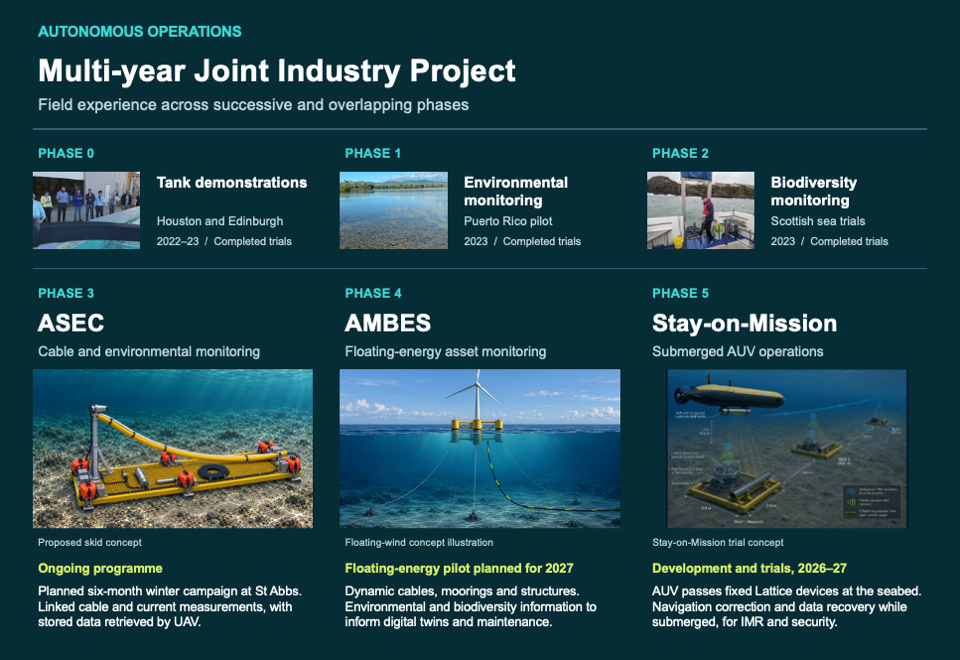
Across five phases, the programme extends from environmental and biodiversity monitoring to subsea cable integrity, floating offshore energy and autonomous underwater inspection. Installed devices process measurements locally, with information recovered through fixed gateways or autonomous vehicles.
Operational deployment
TotalEnergies CLOV3 — pipeline walking
OIS qualified and delivered continuous pipeline walking monitoring systems for TotalEnergies CLOV3 in Angola.
The system supports a "wait and see" integrity strategy by measuring pipeline movement before committing to mitigation. The CLOV3 system is described in OMAE 2026 materials as a world-first continuous pipeline walking monitoring system.
The delivered design provides 10 mm resolution, 16-year battery life and a 1,500 m depth rating.
An uprated design is available with a 3,000 m depth rating, 1.25 mm resolution and up to 30-year battery life.
Programme details and progress
Subsea Wireless 2.0 — magnetic communications, edge processing and cloud backhaul
The Subsea Wireless 2.0 programme validated key Lattice building blocks: low-power edge processing, wireless information transfer through water and through the water-air boundary, SEM integration, UAV backhaul and Azure cloud interface.
Houston and Edinburgh demonstrations showed fatigue information transferred to Azure through UAV / LoRaWAN backhaul, with live information viewed through a QR-linked interface.
Qualification programmes
ASEC and Stay-on-Mission — planned demonstrations
ASEC's next step is a planned six-month winter deployment at St Abbs from 4Q26. The integrated system will measure cable vibration and tilt alongside local currents, retain detailed records subsea and recover compact reports through a UAV gateway. The campaign starts from TRL 6 and targets TRL 7; that target has not yet been achieved.
Stay-on-Mission is Phase 5 of the Autonomous Operations JIP, with development and trials planned across 2026–27. It will test anode identification, motion and tilt monitoring, passive acoustic detection, AUV INS correction and pass-by information recovery while the vehicle remains submerged. Lattice E-Field qualification remains a separate ongoing programme.
AMBES — Phase 4: floating offshore energy
AMBES — OIS's Phase 4 programme for floating offshore energy — plans a Kincardine pilot in 2027. The system covers dynamic cable fatigue below the bend stiffener and at touchdown, mooring and structural response, corrosion, metocean, underwater noise and biodiversity. Hybrid subsea communications, a fixed gateway, topside IMMS and cloud backhaul will keep the asset digital twin and engineering models calibrated for operations planning.
Operators, OEMs, engineering firms and research organisations can join ASEC, AMBES or Stay-on-Mission to influence requirements and success criteria, participate in governance and access the resulting evidence.